How-to
How to Write a Book Summary: One Novel, Four Lengths
To write a book summary, pick its type, state the book in one sentence, then add only the turning points. Worked through on The Great Gatsby.

In brief
- "Book summary" covers four different documents, and whether you give away the ending depends on which one you're writing.
- The classroom rule of 10 to 15 percent of the original fails for books. A good novel summary runs closer to 1 percent.
- Write the whole book as one sentence first, then join each turning point to the next with "but" or "so", never "and then".
- If an AI drafts it, check relationships and cause and effect first. That's where book-length AI summaries go wrong most often.
To write a book summary, decide who it’s for, state the book’s conflict or argument in one sentence, and then add only the events or points that explain where the book ends up. Everything else is detail, however good it is.
This guide works that method on one novel, The Great Gatsby (1925), at four lengths, so you can see what each cut removes and why. It also covers two things most advice skips: why the “10 percent of the original” rule fails for books, and where AI-drafted summaries tend to go wrong.
Decide which summary you’re writing
“Book summary” names at least four different documents, and they disagree on the rule people argue about most: whether to give away the ending. Pick the reader first, because the reader sets the rules.
| Type and reader | Ending | Length |
|---|---|---|
| School summary for a teacher checking that you read it | Included | Set by the assignment |
| Recap for someone who has read the book, or never will | Included | 400–700 words for a novel (Wikipedia) |
| Synopsis for an agent deciding on a manuscript | Always included | 500–1,000 words (Jane Friedman) |
| Blurb for someone deciding whether to read it | Left out | The shortest of the four |
So when one guide says never spoil the plot and another says a summary without the ending is incomplete, both are right about different documents. Most of this guide is about the summary that includes the ending. The blurb comes in at step two of the four lengths below.
Forget the 10 percent rule
A common classroom rule says a summary should run 10 to 15 percent of the original. That works for a five-page article. For a book, it produces something nobody wants to read.
The Great Gatsby is one of the shorter novels on most reading lists, at 48,465 words in the Standard Ebooks edition. Ten percent of that is 4,847 words, more than twice the length of this guide. Wikipedia asks for 400 to 700 words for a full-length novel, which is 0.8 to 1.4 percent of Gatsby. Across the more than 400 book pages in our own library, the plot summary has a median length of 374 words.
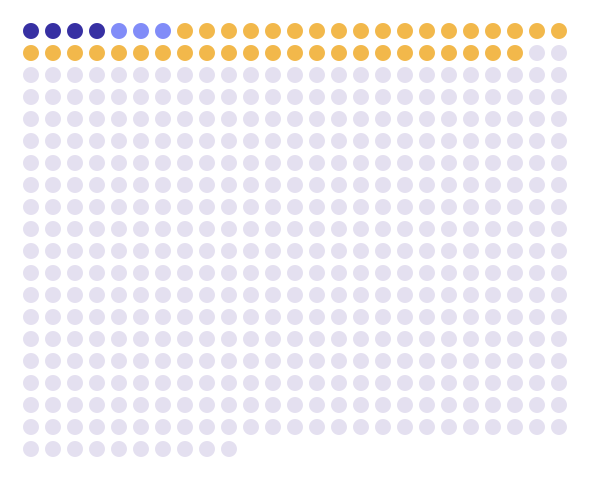
- 4 dots, 374 words: the median plot summary in our library
- 7 dots, 700 words: the top of Wikipedia's range for a novel
- 48 dots, 4,847 words: what a 10 percent rule asks for
- 485 dots, 48,465 words: the whole novel
Aim for about 1 percent, then adjust. A dense history may need more room than a slim novel, because its argument has more parts. If a teacher or an agency gives you a number, that number wins.
Write the one-sentence version first
Before you outline anything, write the whole book as one sentence. It’s the hardest step and the one that saves the most time, because every longer version is this sentence with detail added back.
For a novel, use this frame: someone wants something, but something stands in the way, so something happens in the end.
In The Great Gatsby, Jay Gatsby builds a fortune to win back Daisy Buchanan, but she won’t leave her husband, Tom, so when Daisy, driving Gatsby’s car, kills Tom’s mistress, Gatsby shields her and is shot by the dead woman’s husband.
For nonfiction, change the frame: the author argues a claim, because of the main evidence, so the reader should believe or do something. If you can’t fill the last slot, you haven’t found the book’s point yet. Reread the introduction and the final chapter, where authors usually say it most plainly.
If the sentence won’t come at all, that tells you something useful: you don’t yet know what the book is about, and no amount of outlining will fix that.
Join the turning points with “but” and “so”
Next, list the events that changed the direction of the story, and look at how each one connects to the next. Trey Parker and Matt Stone, the creators of South Park, gave a test for this to an NYU storytelling class in 2011, filmed for mtvU’s Stand In. If the words “and then” belong between two beats of your outline, they said, the story is boring. What belongs there is “therefore” or “but”.
They meant it as advice for writing scripts, but it works even better for editing a summary. A summary that reads “and then… and then…” is a list of scenes. One joined by “but” and “so” explains why the ending happens, which is the whole job.
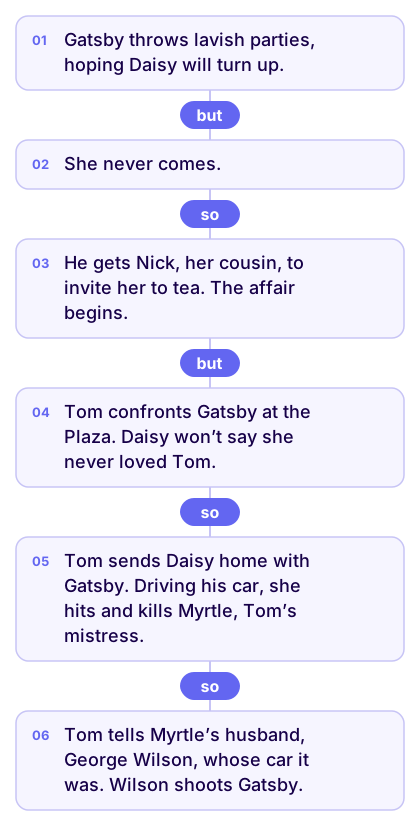
The test also tells you what to cut. Try to connect each event on your list to the one before it with “but” or “so”. When only “and then” fits, the event is usually color, not plot.
Gatsby’s parties are the classic trap. “And then Gatsby throws a party” adds nothing. But in chapter 4, Jordan Baker tells Nick that Gatsby bought the house to be across the bay from Daisy, and hoped she would wander into one of his parties. Now the parties are a cause, and they earn their sentence.
The same novel at four lengths
Here is Gatsby at four lengths, with what goes in at each step and what stays out.
One sentence, 41 words
This is the sentence from the step above. It has the goal, the obstacle, the turn and the ending. It has no narrator, no setting and no date. Nick Carraway, who tells the whole story, isn’t in it at all.
A blurb, 74 words, no ending
In the summer of 1922, Nick Carraway rents a small house on Long Island next to the mansion of Jay Gatsby, a millionaire nobody seems to know, whose parties draw crowds from New York. Across the bay live Nick’s cousin Daisy and her husband, Tom. When Gatsby asks Nick for a favor, Nick learns the parties were never the point. Gatsby has waited five years for Daisy, and he means to get her back.
The narrator and the setting come in, and everything after the setup goes out. A blurb ends on the question the book answers, so a reader who finishes it should know what the book is about and not how it ends. To write one, start from the full summary and cut, rather than starting from scratch.
One paragraph, 131 words
The Great Gatsby is narrated by Nick Carraway, who moves to West Egg, Long Island, in the summer of 1922. His neighbor, Jay Gatsby, throws lavish parties in the hope that Daisy Buchanan, Nick’s cousin and the woman he loved before the war, will turn up. Through Nick, Gatsby meets Daisy again, now married to the wealthy and unfaithful Tom, and they begin an affair. At the Plaza Hotel, Tom accuses Gatsby of bootlegging, and Daisy can’t bring herself to say she never loved Tom. Driving home in Gatsby’s car, Daisy hits and kills Myrtle Wilson, Tom’s mistress. Gatsby protects her, but Tom tells Myrtle’s husband, George, whose car it was. Wilson shoots Gatsby and then himself. Almost no one comes to the funeral, and Nick goes back to the Midwest.
The ending is back, and so are the Plaza confrontation and the empty funeral. Still out: Jordan Baker, the valley of ashes, Gatsby’s past as James Gatz, Meyer Wolfsheim and the green light at the end of Daisy’s dock.
A full page, about 600 words
Our Great Gatsby summary runs 608 words across the plot and the ending, or 1.25 percent of the novel. At that length, Jordan and the valley of ashes come back in, and so does the green light, in the closing section rather than the plot.
That last point is worth noticing. The green light is the most famous image in the book, and it makes none of the three shorter versions, because it doesn’t cause anything. A book’s best-known image or quote usually belongs in an essay about the book, not in its summary.
Novels and nonfiction need different cuts
The method is the same for both, but what you’re tracking is different.
| Novel | Nonfiction | |
|---|---|---|
| The spine | A character’s goal and what blocks it | The author’s central claim |
| Linking words | but, so | because, which means, so |
| Cut first | Scenes that only add color | Anecdotes and repeated examples |
| Ends with | What happened and who changed | What the author concludes or recommends |
| Tense | Present: “Nick moves to West Egg” | Present: “the author argues” |
Nonfiction books often restate the same claim chapter after chapter, each time with new stories. Keep the claim and the kind of evidence behind it, whether that’s studies, case histories or data. Cut the stories unless the argument depends on one of them.
Write it from memory, then check
Here’s a less comfortable fact. In a 2013 review of ten study techniques, John Dunlosky and his colleagues rated summarization “low utility”. It helped some students on some tasks, but only under limited conditions. Practice testing, which means pulling what you’ve learned back out of memory, rated “high utility”.
You can get the benefit of both. Write the first draft with the book closed. Then open it and check every sentence: the names, the order of events, who caused what. The gaps you find are the parts you hadn’t understood. And because you recalled the book rather than copied from it, the summary becomes the kind of practice that the same review rated highest.
If an AI drafts it, check four things
AI can produce a summary in seconds, and it makes a reasonable first draft. But the mistakes it makes are specific, and they aren’t the ones you’d look for first.
In the FABLES study (Kim et al., 2024), people who had read 26 recently published novels checked 3,158 claims made in AI summaries of those books. The best model got 90 percent of its claims right. The others scored 70 to 78 percent. Most of the false claims were about events (31.5 percent) or about the state of a character or relationship (38.6 percent). Half of the false claims could only be caught by reasoning across several parts of the book. Readers also flagged key events that were left out, and even the strongest models gave the end of a book more weight than its beginning.
Those models have since been replaced, but the pattern gives you a checklist:
- Relationships. Who is married to whom, who knows what, and who is still alive at the end.
- Cause and effect. Errors that take several chapters to spot hide in the links between events. Run the “but” and “so” test on the draft and check each link against the book.
- The first third. Make sure the setup gets its share and isn’t squeezed into a line.
- What’s missing. Compare the draft with your own list of turning points. A gap is harder to notice than a mistake.
Before you hand it in
- The first sentence names the book and the author, and says what the book is about.
- It’s in the present tense throughout.
- It reports and doesn’t judge. Opinions belong in a review unless you were asked for them.
- Every character you name comes up at least twice. Jane Friedman gives this test for synopses: if you can get away with mentioning someone once, they probably don’t belong at all.
- The ending is either in or deliberately left out, depending on the reader.
- It’s close to 1 percent of the book, unless you were given a number.
Questions
How do you start a book summary?
Start with the title, the author and one sentence that says what the book is about: the main conflict for a novel, the central claim for nonfiction. Write that sentence before anything else, because the rest of the summary only adds detail to it.
What are the 5 steps of summary writing?
For a book: decide who the summary is for, write the whole book as one sentence, list the turning points and join them with "but" or "so", cut every event that only connects with "and then", and check the draft against the book.
How long should a book summary be?
If you were given a word count, use it. If not, aim for about 1 percent of the book. Wikipedia's guideline for a full-length novel is 400 to 700 words, and a synopsis for a literary agent usually runs one or two pages. A blurb is shorter than any of these.
Should a book summary include the ending?
Yes for a school summary, a recap or a synopsis for an agent. No for a blurb or a recommendation, because those are written for someone who hasn't read the book yet.
How do you write a book summary for the back cover?
Write the full summary first, then cut everything after the setup. Keep the main character, the situation and the central question, and stop before anything is resolved.